
GreRoyalt
By Lekai Xu, Partner | GreRoyalt Law Firm


Business Question
If your company holds a trademark portfolio in China — whether a domestic brand built up over many years or a multinational that has only recently entered the market — you have likely heard, over the past few weeks, that China's Trademark Law has undergone a major overhaul. Social media commentary has been mixed: some say the higher damages cap finally gives rights holders real leverage; others warn that registration will become harder; still others note that trademark agencies now face tighter scrutiny. None of these takes is wrong, but each only captures part of the picture.
The question worth a company's time is not “which provisions changed,” but a more fundamental one: will this revision change the trademark management practices we have relied on for the past decade or two?
Our answer is: yes, and the scope of the change is considerably larger than most companies currently expect. This is not a minor compliance update — it is a systemic event that calls for companies to revisit their entire trademark management framework, from filing strategy and use evidence to enforcement pathways. That is why we have chosen to address this revision across a ten-part series rather than a single bulletin.
Legal Update
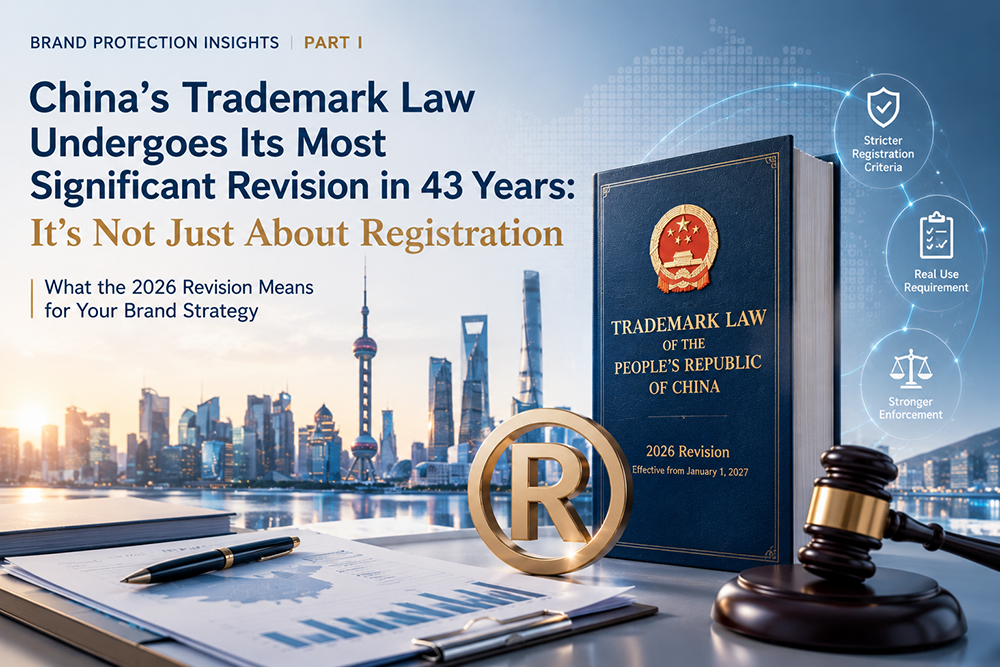
On June 26, 2026, the 23rd Session of the Standing Committee of the Fourteenth National People's Congress adopted a newly revised Trademark Law of the People's Republic of China, which will formally take effect on January 1, 2027. This is the fifth change to the Trademark Law since it first took effect in 1983. The four prior changes, in 1993, 2001, 2013 and 2019, were each implemented through a decision amending specific provisions; this time, the Standing Committee adopted a comprehensive revision, restructuring the Law as a whole.
As to the text itself: the revised Law comprises nine chapters and eighty-seven articles, fourteen more than the current eight-chapter, seventy-three-article text. Two structural changes stand out. First, a new standalone Chapter II, “Conditions for Trademark Registration,” consolidates requirements previously scattered across the filing and examination chapters, making it easier for companies and agencies to understand what may and may not be registered. Second, the opposition, review, and invalidation procedures formerly combined under a single “trademark review” chapter have been separated, with invalidation now standing as its own Chapter VI, distinct from the examination and confirmation procedures.
Beyond the structural reorganization, the substantive changes running through the Law include: further refinement of registration conditions (a new catch-all standard in Article 19 for applications “not filed for the purpose of use and obviously exceeding what is reasonably required for normal business operations,” with strengthened scrutiny of bad-faith applications); reinforced genuine-use obligations (the non-use cancellation rule in Article 57 and the non-use defense in Article 78); a faster examination and confirmation timeline (the opposition period shortened from three months to two); a comprehensively restructured framework for trademark agency oversight (new Articles 65 through 68); and further refinement of the infringement damages regime (the statutory cap raised from RMB 3,000,000 to RMB 5,000,000). We will examine each of these in the nine installments that follow.
Practical Analysis
Why now? A set of figures is worth a company's attention here. By the end of 2024, China's cumulative trademark registration applications had exceeded 80 million, with nearly 50 million trademarks in force — both figures the highest in the world. But alongside this growth, the problem of “heavy registration, light use” has continued to accumulate: a large number of trademarks sit registered but unused, tying up limited examination resources and making it increasingly difficult and time-consuming for genuine market participants to obtain registration. Officials at the China National Intellectual Property Administration have stated that the basic approach behind this revision is to “build a high-standard trademark legal system with Chinese characteristics, aligned with international trends, suited to future development, and benefiting hundreds of millions of business entities.” That last phrase — benefiting hundreds of millions of business entities — is worth dwelling on: it signals that the revision's purpose is not merely to curb a minority of bad-faith filers, but to redistribute the resources of the entire trademark system so that companies genuinely operating and using their trademarks find it easier to obtain protection.
The legislative process itself offers useful context. As early as 2023, the China National Intellectual Property Administration released a considerably more aggressive exposure draft for public comment, which at one point expanded to ten chapters and 101 articles. That draft proposed a “one mark per class” rule against duplicate filings, a requirement that rights holders submit a use declaration every five years, and a mechanism for forcibly transferring bad-faith registrations in invalidation proceedings — proposals that, given their disruptive effect on companies' existing “first-to-file” portfolio strategies, proved controversial. Over the nearly three years of deliberation that followed, through multiple rounds of discussion and consultation, most of these more contentious proposals were scaled back or dropped altogether, resulting in a considerably more measured and predictable final text.
We think the signal sent by this legislative process matters as much as the text itself for understanding the spirit of the new Law: regulators are seeking a more measured balance between cracking down on bad-faith registration and protecting ordinary commercial activity, rather than simply raising compliance thresholds across the board for all market participants. This means companies need not view the revision with undue alarm — but should not be complacent either. What genuinely warrants adjustment is the kind of trademark portfolio built on a “file first, figure out the rest later” approach, without a genuine plan for use.
Practical Impact
For companies, what this revision truly changes is not any single rule, but the underlying standard by which the trademark system assesses whether a company genuinely holds trademark rights. For more than four decades, the operating logic of China's trademark system has been relatively simple: whoever files first, registers first, holds the right — with comparatively limited institutional attention to whether, or how fully, that trademark is actually used after registration. This “heavy registration, light use” logic has shaped trademark management habits across generations of companies: defensive stockpiling, pre-emptive filings in peripheral classes with no concrete business plan, reliance on agencies for low-cost bulk filing, and registrations left dormant for years without any active effort to document use.
Under the new Law, genuine use and good-faith filing will increasingly become substantive factors in whether a trademark right can be obtained, whether it can be maintained, whether it can withstand opposition and invalidation proceedings, and whether it can support full compensation in an infringement action — rather than a peripheral concern confined to the registration stage. This means several practices many companies have long taken for granted now warrant a fresh look at their compliance risk and real commercial value: defensive registrations filed merely to “hold a place,” without a concrete plan for use, face a materially higher risk of refusal or cancellation going forward; trademarks left dormant and unused for years, however long they have been on the register, are no longer “safe assets” by default; and a practice of simply relying on agencies for low-cost bulk filing, without scrutinizing whether the underlying filing strategy is sound, now carries indirect risk for the brand owner itself, given the heavier accountability the new Law imposes on agencies and their practitioners.
GreRoyalt Observation
We have observed that the evolution of China's trademark system over the past several years has followed a fairly consistent thread: a gradual shift from straightforward “registration administration” toward something closer to “brand governance” in the broader sense. This thread has already been visible in recent judicial and administrative enforcement trends — the standards for finding “bad faith” in opposition and invalidation proceedings have grown more refined, administrative authorities have stepped up enforcement against “gimmick trademarks” and misleading use, and courts have become increasingly specific about the use evidence they expect rights holders to submit when determining infringement damages. This revision is not an abrupt turning point on that thread — it is the point at which the thread has been formally and systematically written into the law itself.
Building on that view, our preliminary read on the next five years is this: trademark management will no longer sit as a relatively isolated, periodic compliance task within a company's legal department. It will become increasingly embedded in product launch timing, marketing strategy, e-commerce and social media content management, and even supply chain and channel-partner management. In other words, the answer to “who is responsible for trademark management” may no longer rest solely with legal or IP teams — it will likely require coordinated involvement from marketing, e-commerce operations, and channel management as well. We will return to this theme in greater depth later in the series, particularly in Part VIII.
Practice Checklist
✓ Conduct a full audit of your existing trademark portfolio to identify registrations lacking genuine use evidence or a concrete business plan.
✓ Reassess your defensive filing strategy, clearly distinguishing genuine defensive registrations tied to real business expansion plans from registrations filed merely to hold a place with no plan for use.
✓ Begin planning a use-evidence retention process now, and follow the remaining installments in this series to understand the specific changes to opposition, invalidation, and infringement damages — so your organization is not caught reacting after the Law takes effect on January 1, 2027.
In the next installment: “Is It Time to Rethink Your Trademark Filing Strategy?” — examining the refined registration conditions and strengthened scrutiny of bad-faith applications under the new Law, and how companies should systematically adjust their filing and defensive registration strategies in response.
This article is provided for general informational purposes only and does not constitute legal advice for any specific matter. Please consult qualified counsel regarding your particular circumstances.


 沪公网安备:31010402008386号