
GreRoyalt


In intellectual property criminal enforcement cases, the first raid is often only the beginning.
Once a counterfeit manufacturing site is raided, information typically spreads rapidly within the infringing network. Production may be suspended, inventory relocated, business entities changed, and sales channels shut down. As a result, the period immediately following the first enforcement action is often the stage at which a case becomes most vulnerable to disruption.
Recently, Michelle XU and her team assisted a renowned international footwear brand in two trademark counterfeiting cases that faced precisely this challenge.
Following the successful enforcement action against the first counterfeit operation, related infringers had already begun to show clear signs of heightened awareness, and certain online sales channels ceased operation. Faced with the risk that counterfeiters might relocate inventory or otherwise evade enforcement, the authorities moved swiftly to carry out a second operation. Ultimately, another interconnected counterfeiting network was successfully dismantled, multiple manufacturing and storage facilities were brought under control, and the responsible individuals became subject to criminal measures.
As the two operations unfolded, the full nature of the infringement scheme became apparent.
The targets were not isolated sellers or small-scale traders. Instead, they formed an organized network encompassing manufacturing, warehousing, and sales activities. Through multiple distribution channels, counterfeit products were continuously supplied to the market, supported by a production system capable of sustained and large-scale output.
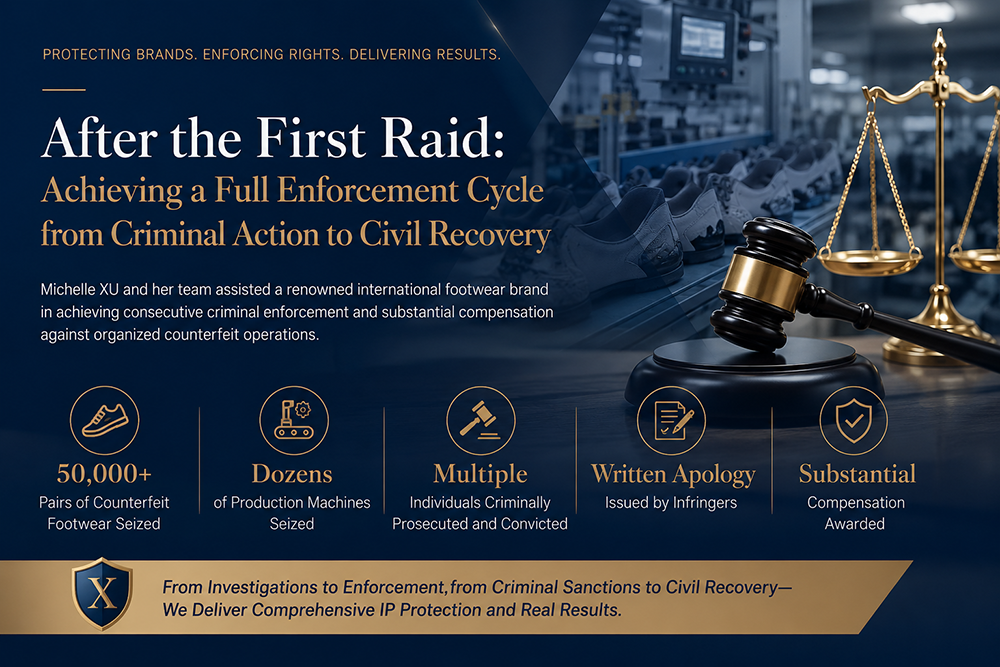
Across the two operations, more than 50,000 pairs of counterfeit footwear were seized. Large quantities of shoe materials, packaging materials, and related components were also confiscated. In addition, dozens of production machines and manufacturing facilities were seized, dealing a substantial blow to the counterfeiters’ production capacity.
From a brand protection perspective, this outcome carried particular significance.
In many enforcement actions, only finished counterfeit products are seized. In this case, however, the authorities were able to secure not only infringing goods but also the production equipment and manufacturing infrastructure behind them. As a result, what was disrupted was not merely a stockpile of counterfeit products, but the very capacity to continue producing them.
The cases subsequently proceeded through the criminal justice system, and multiple defendants were ultimately convicted and held criminally liable. The resulting criminal judgments not only confirmed the infringing conduct but also reflected the judiciary’s firm stance against large-scale and industrialized trademark counterfeiting activities.
In parallel with the criminal proceedings, the rights holder continued to pursue civil enforcement measures. Faced with the established facts of infringement and the criminal convictions, the infringers ultimately issued written apologies to the rights holder and paid substantial compensation.
The matter therefore achieved a complete enforcement cycle—from criminal action to civil recovery.
From the continued pursuit of enforcement after the first target had already become alert, to the dismantling of two counterfeit supply chains; from the seizure of more than 50,000 counterfeit products to the confiscation of dozens of production machines; and from criminal convictions to public apologies and compensation, the cases not only protected the rights holder’s legitimate interests but also struck at the source of the counterfeiting operations.
In recent years, counterfeiting activities have become increasingly organized and industrialized. As a result, brand protection efforts have evolved beyond simply removing infringing products from the marketplace. More and more international brands are focusing on the production systems and operational networks behind counterfeit goods. Only by increasing the overall cost of infringement and limiting the ability of counterfeiters to continue operating can long-term and effective protection be achieved.
These cases exemplify the practical value of that approach. Through the combination of criminal enforcement, civil recovery, and source-level disruption of counterfeiting operations, Michelle XU and her team assisted the rights holder in carrying out consecutive actions against two counterfeit supply chains and ultimately achieved a full enforcement cycle from infringement detection and criminal accountability to compensation recovery, providing a representative example of how international brands can combat industrialized counterfeiting activities in China.


 沪公网安备:31010402008386号