
GreRoyalt
The Data Competition Rules Established by Guiding Case No. 262 of the Supreme People's Court
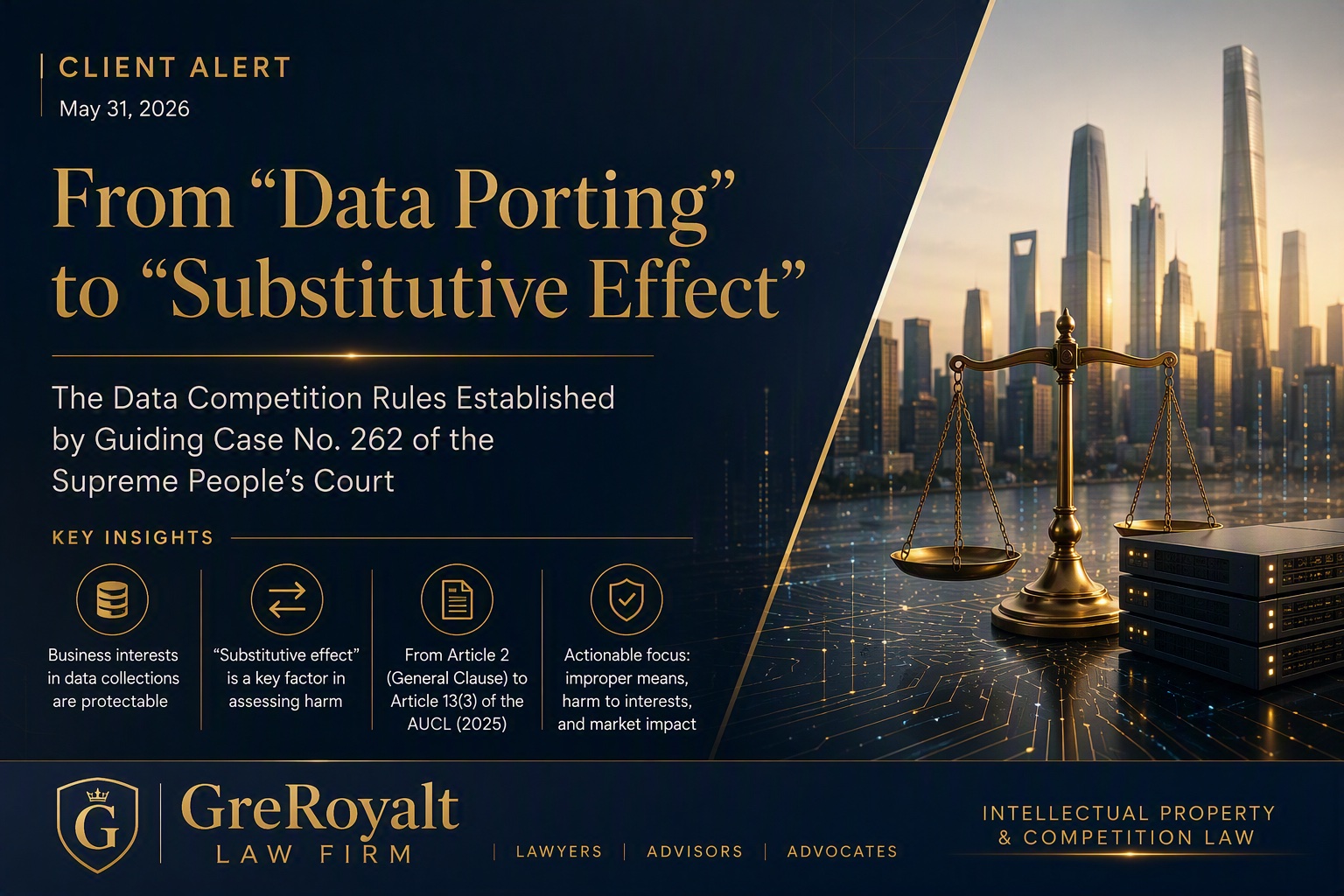


Key Takeaways
Guiding Case No. 262 confirms that a dataset accumulated through an operator’s legitimate business activities may embody legally protected business interests.
The case does not recognize any general proprietary right in data. Instead, protection is afforded under the Anti-Unfair Competition Law to the competitive interests arising from the formation and operation of a data collection.
The concept of “substitutive effect” constitutes an important factor in assessing competitive harm in the case, but should not be understood as a universal test applicable to all data-related disputes.
The 2025 amendments to the Anti-Unfair Competition Law introduced a dedicated provision governing data-related unfair competition, signaling the transition of Chinese data competition law from judicial exploration toward a more explicit statutory framework.
Why Can a Platform Assert Protectable Interests in Its Data Collection?
Disputes concerning data scraping, data migration, and data utilization have become increasingly common in the digital economy. Unlike patents, trademarks, or copyrights, however, data itself is not subject to a unified system of exclusive proprietary rights. As a result, the key legal question in many data disputes is not whether a competitor has used the relevant data, but whether the affected business possesses a legally protectable interest capable of attracting legal protection.
Guiding Case No. 262 addresses precisely this issue. In that case, the defendant obtained and used a substantial volume of short videos, user nicknames, avatars, and user comments from the plaintiff's platform without authorization, and subsequently made such content available through its own platform.
The legal difficulty arose because the platform operator was not the creator of the relevant short videos. Although certain videos constituted copyrightable works while others qualified as audiovisual recordings, the platform itself was not the producer of such content. Moreover, the platform's classification, organization, and display of the content did not meet the originality threshold required for a compilation work under copyright law. Consequently, the platform could not automatically rely on copyright law to claim rights in the dataset as a whole.
Rather than expanding the boundaries of traditional intellectual property protection, the courts approached the dispute through the framework of unfair competition law. The dataset at issue was not viewed as a mere aggregation of individual pieces of content. Instead, it was regarded as a business asset developed through sustained investments in technology, operations, platform governance, and user acquisition. The resulting dataset possessed economic value independent of any individual short video and generated competitive advantages for the platform. Accordingly, the business interests arising from the holding, operation, and commercial exploitation of that dataset were deemed worthy of legal protection.
Importantly, the Guiding Case does not employ concepts such as “data ownership” or any analogous proprietary entitlement. Rather, it identifies the protectable interest as the business interest generated through the accumulation, maintenance, and operation of the dataset. In other words, the law protects the competitive value created by legitimate business efforts, not the abstract notion of ownership over data itself.
The Guiding Case further makes clear that protection of a platform's business interests does not affect the ability of content creators to assert their rights under copyright law. The rights of individual creators and the business interests of platform operators therefore exist at different levels and may coexist within the broader legal framework.
Why Did “Substitutive Effect” Become a Critical Factor in the Court’s Analysis?
Another significant contribution of Guiding Case No. 262 lies in its approach to assessing competitive harm.
In data competition disputes, it is often tempting to focus exclusively on whether authorization was obtained before data was accessed or used. The case demonstrates, however, that competition law is equally concerned with the market impact of the challenged conduct.
The defendant did not merely obtain data from the plaintiff's platform. It used the acquired data to provide users with highly overlapping content and services through its own platform. As a practical matter, users could obtain substantially the same information and viewing experience without accessing the plaintiff's platform at all.
Against this backdrop, the court found that the defendant's conduct produced a genuine substitutive effect on the plaintiff's products and services and, in doing so, impaired the plaintiff's business interests arising from its dataset.
The notion of “substitutive effect” is therefore an important analytical concept in understanding the court's reasoning. Its significance lies not in establishing a universal standard applicable to all data disputes, but in illustrating how competitive harm materialized in the specific circumstances of the case.
For future disputes involving data aggregation services, search engines, recommendation systems, content platforms, or web crawlers, whether a particular use of data creates a substitutive effect may remain a relevant consideration. Nevertheless, any assessment of competitive harm must continue to take into account a broader set of factors, including the method of data acquisition, the extent of data utilization, the competitive relationship between the parties, and the actual impact on market competition.
From the General Clause to the Dedicated Data Provision
The broader significance of Guiding Case No. 262 becomes more apparent when viewed against the evolution of China's data competition regime.
The conduct at issue occurred before the implementation of the 2025 amendments to the Anti-Unfair Competition Law. As a result, the case was primarily decided under the general principles embodied in Article 2 of the statute, namely the principles of good faith and fair competition.
At the same time, the case emerged during a period of significant legislative development. The 2025 amendments introduced a dedicated provision addressing data-related unfair competition. Article 13(3) now provides that business operators shall not obtain or use data lawfully held by others through improper means such as fraud, coercion, circumvention of technical protection measures, or interference with such measures, where such conduct harms the legitimate rights and interests of other operators or disrupts market competition.
The importance of this provision lies in what it does not do. The new rule does not grant operators a general exclusive right over lawfully held data, nor does it establish a blanket prohibition against the use of data without authorization.
Instead, the provision preserves the traditional conduct-regulation logic of competition law. The legal inquiry remains focused on whether the means of obtaining or using data are improper and whether the conduct causes legally cognizable harm to the rights and interests of others or to the competitive process itself.
Accordingly, the legality of any particular data acquisition or utilization practice must still be evaluated in light of the methods employed, the interests affected, and the impact on competition. Understanding this distinction is critical to avoiding the misconception that the data provision functions as a statutory form of data ownership.
Viewed from a broader perspective, Guiding Case No. 262 represents an important bridge between judicial development and legislative codification. The progression is clear: judicial practice first recognized the protectability of business interests embodied in datasets; the Guiding Case then articulated and consolidated the underlying principles; and finally, the legislature incorporated those principles into a dedicated statutory provision.
What Does This Mean for Platform Operators and AI Companies?
It is important to note that Guiding Case No. 262 did not involve generative artificial intelligence or the use of publicly available online data for model training. Accordingly, the case should not be regarded as an AI training data precedent.
Questions concerning AI training data typically involve a much broader set of legal issues, including copyright, privacy, trade secrets, contractual restrictions, technical access controls, and the potential substitutive effects of model outputs. The Guiding Case does not directly resolve these questions.
Nevertheless, the analytical framework reflected in the case remains highly relevant. Whether in the context of data scraping, data aggregation, API access, or AI training datasets, businesses are increasingly likely to confront a common set of inquiries:
How was the data obtained?
By what means was access achieved?
How is the data subsequently used?
Does such use impair competitive interests legitimately developed by another operator?
Does the conduct produce competitive harm, including but not limited to substitutive effects?
As data-intensive business models continue to evolve, these considerations are likely to play an increasingly important role in future disputes involving both traditional digital platforms and AI-driven technologies.
Our Observations
Guiding Case No. 262 does not establish a new form of data ownership. Rather, it articulates a framework for analyzing competition in the data economy. The case confirms that datasets developed through legitimate business activities may embody protectable business interests, while the legality of data acquisition and use must be assessed by reference to the methods employed and the competitive effects produced.
With the introduction of the data-specific provision in the Anti-Unfair Competition Law, a body of principles that initially emerged through judicial practice is now moving into a more explicit statutory framework.
For platform operators, data service providers, and AI companies, the key questions in future data competition disputes are unlikely to be limited to who owns the data. Instead, the more meaningful inquiries will be:
How was the data obtained? How is it being used? And what competitive effects does such use create?
Author
Xu Lekai | Partner
GreRoyalt Law Firm | Shanghai Tian An Yong Dao Law Firm
Disclaimer
This publication is based solely on publicly available information and the laws and regulations in force as of the date of publication. It is intended to provide general information on intellectual property protection, trade secret management and corporate compliance. It does not constitute legal advice in relation to any specific matter, facts or person. Companies should seek tailored legal advice when addressing trade secret protection, employee mobility, non-compete arrangements or technology acquisition.


 沪公网安备:31010402008386号