
GreRoyalt
Compliance Lessons from Six Recent Cases Published by China’s State Administration for Market Regulation
From individual enforcement actions to emerging trends in corporate trade secret governance
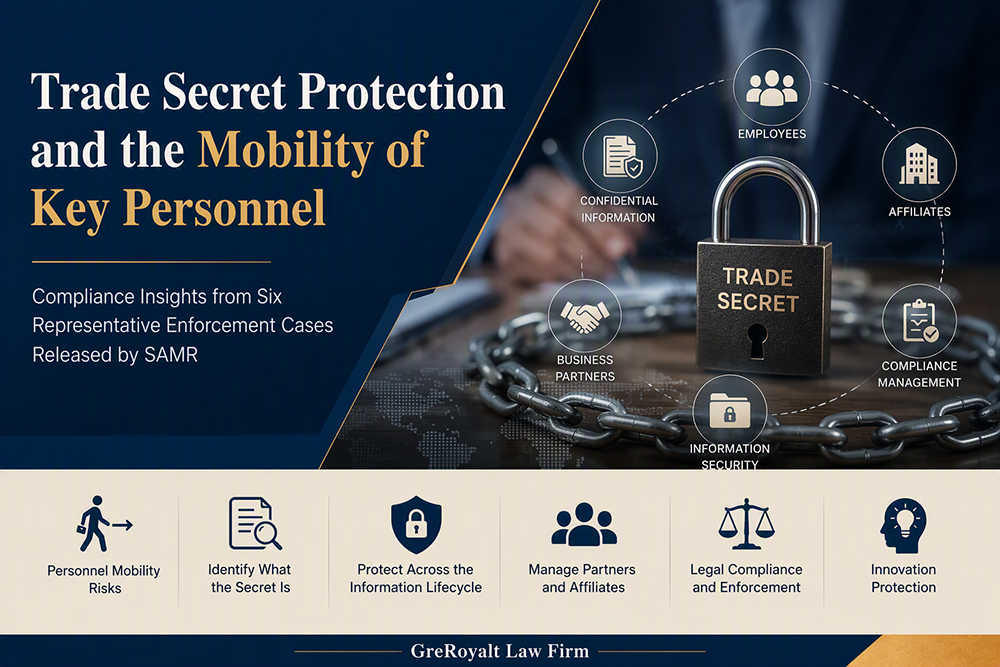


Introduction
The State Administration for Market Regulation (SAMR) recently published six representative trade secret infringement cases spanning artificial intelligence, advanced equipment manufacturing, precision instruments, new materials and digital content.
Notably, the risk landscape reflected in these cases extends well beyond the familiar scenario of a departing employee taking technical materials. Based on the published facts, risks may arise after an employee leaves, but may equally begin while the employee remains employed. They may originate
with key research and development personnel and may extend to external contractors, related parties, and recipients or users of technical information.
The publication of China’s first trade secret case involving a vertical-domain AI model also illustrates how the trade secret regime is responding to new forms of technical assets in the AI era.
For companies, the central lesson is not merely how to respond to a suspected leak. It is how to build a trade secret governance framework spanning research and development, workforce management, third-party relationships and technology acquisition.
Key Takeaways
· Trade secret risks now extend beyond departing employees to the broader movement of personnel and information.
· A company that receives and uses another party’s trade secrets may itself face liability.
· Successful enforcement begins with identifying precisely what the asserted trade secret is.
· New forms of technical information in the AI sector are increasingly being considered for trade secret protection.
· Non-compete arrangements are not a substitute for a robust trade secret management framework.
· Companies should implement a lifecycle-based trade secret governance system.
1. Personnel-related risks extend well beyond departing employees
Companies have traditionally focused their trade secret controls on the employee exit process. The six representative cases published by SAMR, however, show that risks can arise at every stage of personnel movement.
In some cases, former employees used technical information obtained from their previous employer to establish competing businesses and engage in competing operations. In others, the risk had already materialised before the employee’s departure. Certain key technical personnel disclosed R&D materials to competing businesses under their control while still employed; other cases involved the transfer of technical drawings, R&D materials or digital content through personal email accounts, removable storage devices or other channels.
The cases also illustrate how personnel at external contractors, business partners and third-party recipients may become involved in the flow of confidential information. Trade secret protection therefore cannot depend solely on exit procedures, confidentiality agreements or non-compete clauses. Companies must understand how information moves throughout its lifecycle and identify every person and entity with access to it.
Of particular significance, enforcement authorities did not limit their scrutiny to the individuals who directly disclosed the information. In certain cases, they also examined how technical information was received and used. A company that knows or should know that information was obtained in breach of a confidentiality obligation, but nevertheless acquires, uses or permits others to use that information, may itself face legal liability.
Trade secret protection should therefore be treated not merely as an employment issue, but as part of a company’s broader innovation governance framework.
2. Before enforcing a trade secret, a company must establish what the secret is
Unlike patents and trade marks, trade secrets do not acquire defined legal boundaries through a registration or grant procedure.
Under Article 10 of the current Anti-Unfair Competition Law of the People’s Republic of China, a trade secret is technical information, business information or other commercial information that is not known to the public, has commercial value, and is subject to corresponding confidentiality measures taken by the rights holder.
In practice, many trade secret claims encounter difficulties before any substantive comparison with the allegedly infringing information takes place, because the rights holder cannot clearly define the information claimed as secret, has insufficient supporting records, or failed to implement adequate confidentiality measures.
When asserting that technical materials constitute a trade secret, a company should generally be able to explain:
· the specific subject matter for which protection is claimed;
· the information comprising the claimed secret;
· when the information was created;
· where it is stored;
· who has had access to it; and
· the specific confidentiality measures applied to it.
Many companies label broad categories of materials as “confidential” or “internal”. When a dispute arises, however, they may still be unable to identify precisely what information is claimed as a trade secret. These are not peripheral evidentiary details; they form the basis for any subsequent infringement analysis and determination of liability.
The first question in trade secret protection is therefore not how to pursue a wrongdoer, but how to define and substantiate the information assets the company genuinely seeks to protect. Trade secret management is, in this sense, an ongoing governance function rather than a reactive measure taken only after a dispute arises.
3. AI-era technical information is entering the scope of trade secret protection
The most closely watched of the six cases is China’s first trade secret case involving a vertical-domain AI model.
According to the published case summary, following expert assessment, the enforcement authority concluded that the company’s proprietary prompt templates, review rules and annotation specifications, taken together as an “integrated scenario-based intelligent review solution”, satisfied the requirements of non-public availability, commercial value and corporate confidentiality controls. The solution was therefore recognised as a new form of integrated technical trade secret in the vertical AI sector.
The significance of the case is not that every prompt or workflow automatically qualifies as a trade secret. Rather, it demonstrates the adaptability of trade secret protection to new forms of technical assets in the AI era.
AI companies have historically focused their intellectual property strategies on patent filings, software copyright registrations and source-code protection. In practice, however, a substantial part of their competitive advantage may lie not in the code itself, but in accumulated data governance methodologies, business rule sets, knowledge architecture and scenario-specific solutions.
Examples may include:
· data governance methodologies;
· business rule sets;
· knowledge architecture;
· prompt template systems;
· scenario-specific solutions; and
· agent workflow design.
For information assets that should not be disclosed, cannot be fully protected through patents, or evolve continuously, trade secret protection is becoming an increasingly important part of the protection strategy. The case therefore provides a useful reference point for AI companies, platform businesses and other data-driven enterprises.
4. Confidentiality agreements, non-competes and trade secret protection are distinct mechanisms
Companies often regard non-compete arrangements as a principal means of protecting trade secrets. Legally, however, the two regimes are distinct. A non-compete primarily addresses whether, within an agreed scope, territory and period, a specified employee may work for a competing employer or independently engage in a competing business. Trade secret law focuses on the information itself and on whether a person or entity has unlawfully acquired, disclosed, used or permitted others to use it.
Accordingly, trade secret liability may arise even in the absence of a non-compete agreement. Conversely, the existence of a non-compete does not, by itself, establish that the company is entitled to trade secret protection.
Non-compete obligations also cannot be imposed indiscriminately on all employees. Under current PRC employment law, they are limited to:
· senior management personnel;
· senior technical personnel; and
· other personnel subject to confidentiality obligations.
During a post-termination non-compete period, the employer must pay economic compensation in accordance with law and the parties’ agreement, and the restricted period may not exceed two years. For key positions with access to sensitive information, companies should therefore establish a coordinated framework combining confidentiality agreements, substantive trade secret controls and appropriately tailored non-compete arrangements, rather than relying on any single instrument.
5. Moving from policy documents to trade secret governance
The cases show that companies need more than a collection of confidentiality documents. They need a governance framework covering the creation, use, circulation and retirement of trade secrets.
First, companies should establish mechanisms for identifying and dynamically managing trade secrets. Trade secret inventories should be reviewed and updated as R&D progresses, patent applications are filed, technologies are disclosed and personnel change. Information that has entered the public domain or lost its commercial value should be reclassified, while newly created and commercially significant technical information should be brought within the protection framework promptly.
Second, access controls should form part of day-to-day operations. Questions such as who may access particular information, the extent of that access, whether access and download activity is logged, and whether anomalous behaviour is monitored are not merely information security matters; they may directly affect a company’s ability to prove its rights in a future dispute.
Third, the cases underscore the importance of contractor and business partner management. Agreements with suppliers, external processors, technical advisers and joint R&D partners should clearly define:
· the scope of confidential information;
· the permitted purpose of use;
· access permissions;
· restrictions on onward disclosure or sublicensing; and
· return, deletion and destruction obligations upon termination of the relationship.
Companies should also implement personnel controls throughout the employment lifecycle, from onboarding and ongoing employment through to departure, together with source-review procedures for external technologies and technical hires. Avoiding involvement in another party’s trade secret dispute on the basis that the company “knew or should have known” is itself an important compliance objective.
Finally, when a suspected leak occurs, it is critical to preserve server logs, access records, download histories, emails and other electronic evidence promptly. Whether a case can proceed effectively will often depend not only on the technical facts and legal analysis, but also on whether the company has preserved key evidence in a timely and complete manner.
Lawyer’s Perspective
Historically, companies tended to focus on preventing departing employees from taking confidential materials. The cases discussed above reveal a broader development: trade secret protection is evolving from a personnel-management issue into a corporate governance issue. This is particularly relevant in artificial intelligence, advanced manufacturing and digital content, where competitive advantage increasingly resides in rule sets, data resources, scenario-specific know-how and institutional knowledge.
Effective trade secret management should therefore not be limited to executing confidentiality agreements, imposing non-compete obligations or deploying technical safeguards. Companies should establish an enduring governance framework centred on four questions: what information is protected, who may access it, how it may circulate, and how the company will prove its rights if challenged. For innovation-driven businesses, trade secret protection is not merely a compliance requirement; it is increasingly an integral part of innovation governance and competitive strategy.
Author
Xu Lekai | Partner
GreRoyalt Law Firm | Shanghai Tian An Yong Dao Law Firm
Disclaimer
This publication is based solely on publicly available information and the laws and regulations in force as of the date of publication. It is intended to provide general information on intellectual property protection, trade secret management and corporate compliance. It does not constitute legal advice in relation to any specific matter, facts or person. Companies should seek tailored legal advice when addressing trade secret protection, employee mobility, non-compete arrangements or technology acquisition.
Legal Authorities and Reference Materials
· State Administration for Market Regulation, Six Representative Trade Secret Infringement Cases, 20 August 2026.
· Anti-Unfair Competition Law of the People’s Republic of China (2025 Revision).
· Labor Contract Law of the People’s Republic of China.
· Interpretation (II) of the Supreme People’s Court on Issues Concerning the Application of Law in the Trial of Labor Dispute Cases.
· Provisions of the Supreme People’s Court on Several Issues Concerning the Application of Law in the Trial of Civil Cases Involving Trade Secret Infringement.


 沪公网安备:31010402008386号