
GreRoyalt
By Lekai Xu, Partner | GreRoyalt Law Firm


Editorial Note on Article Numbering: This article discusses opposition and invalidation practice under the current Trademark Law. Current Article 30 will be renumbered as Article 20, and current Article 13(3) (cross-class protection for well-known marks) will be renumbered as Article 21(2), under the amended Trademark Law taking effect on January 1, 2027. The basic protection logic of these provisions carries forward, though the amended law also makes certain substantive adjustments to well-known-mark protection (for example, current Article 13(3) requires the well-known mark to be “already registered in China,” a requirement Article 21(2) removes). This article focuses on the structural relationship between the “ordinary similar-mark protection path” (for identical or similar goods/services) and the “well-known-mark cross-class path” (for dissimilar goods/services), rather than surveying every change to well-known-mark protection under the amended law. To avoid confusion once the amended law takes effect, this article gives the current article number together with its counterpart under the amended law at first mention, and thereafter uses the shorthand “Article 30 path” and “well-known-mark cross-class path.”
Business Question
In trademark opposition and invalidation cases, many brand owners bringing the challenge are in the habit of entering every significant prior mark into the “cited mark” field, on the view that this broadens the basis for protection and improves the odds of success. But a “cited mark” is not synonymous with every prior right invoked in a submission; in cases that also assert cross-class protection for a well-known mark, this “more can only help” habit can instead create an internal contradiction within the statement of grounds. In practice, structuring the legal bases in a statement of grounds regularly requires balancing covering as many prior rights as possible against keeping each individual argument internally consistent. The core question is: what exactly is a “cited mark”? Which prior marks should—and should not—be entered in that field?
Legal Framework
In trademark examination and adjudication practice, and in CNIPA's online filing system, a “cited mark” generally refers to a prior mark that must be compared against the disputed mark—on both mark similarity and goods/services relationship—under relative grounds such as current Article 30 (Article 20 under the amended law) and Article 31 of the Trademark Law. This comparison logic inherently presupposes that the goods/services at issue are identical or similar—that is a precondition for this operational term to apply, not an extraneous limitation. (For brevity, this article refers to the similarity-review rule under current Article 30 as the “Article 30 path.”)
The China National Intellectual Property Administration's 2022 Guidelines for Online Filing of and Response to Trademark Invalidation Applications state expressly that cited-mark information need only be added where the grounds for invalidation “relate solely to Articles 30 and 31 of the Trademark Law.” This indicates, at minimum, that in the online invalidation filing process, “cited mark” information corresponds primarily to grounds under Articles 30 and 31, and does not necessarily extend to every prior mark or other prior right invoked elsewhere in the submission. This guideline was issued under the current article numbering; the specific article numbers may shift once the amended law takes effect, though the underlying logic for completing the “cited mark” field remains instructive.
By contrast, cross-class protection for well-known marks under current Article 13(3) (Article 21(2) under the amended law taking effect January 1, 2027)—referred to here as the “well-known-mark cross-class path”—has, as one of its statutory elements, the requirement that the goods/services of the disputed mark be not identical with or similar to those of the well-known mark. In other words, the Article 30 path and the well-known-mark cross-class path rest on two mutually exclusive findings on one specific issue—whether the goods/services are “similar” or “dissimilar”—not on whether the marks themselves are similar (indeed, the well-known-mark cross-class path itself requires the disputed mark to copy, imitate, or translate the well-known mark, so a high degree of mark-level similarity may well be present in both scenarios).
Core Risk
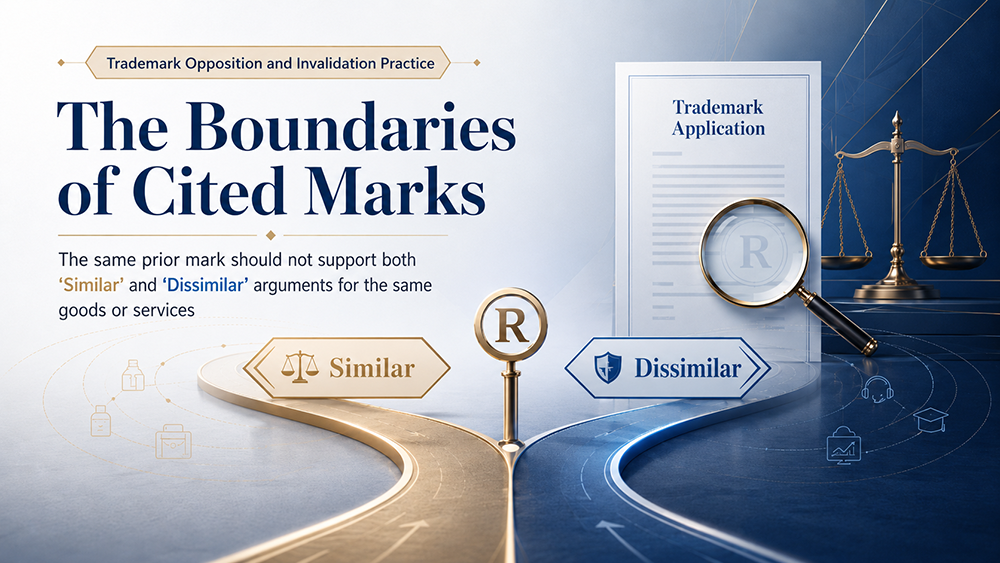
This structural feature creates a pitfall that is easy to overlook but can be costly: if the same prior mark is entered as a cited mark under the Article 30 path (asserting the goods/services are similar) while also being relied upon under the well-known-mark cross-class path (asserting the goods/services are dissimilar), the statement of grounds creates a direct internal contradiction.
The CNIPA adjudicator reviewing the submission will see the party bringing the challenge assert “similar” for purposes of the Article 30 path and “dissimilar” for purposes of the well-known-mark cross-class path in the same document. Rather than strengthening protection, this undermines the adjudicator's confidence in that party's competence and consistency on goods/services similarity, and by extension in the overall quality of the submission.
To be clear, this caution does not mean the two paths can never coexist in the same case. The issue arises specifically where the same prior mark, applied to the same set of goods/services, is affirmatively argued as both “similar” and “dissimilar” without any differentiation. A statement of grounds may legitimately plead the two on an alternative basis—for example, “if CNIPA finds the goods/services to be similar, the Article 30 path applies; if not, the well-known-mark cross-class path applies”—but only if it expressly states the distinct premises of each argument and their primary or alternative pleading structure, so the adjudicator does not read it as an undifferentiated double assertion.
It is also worth distinguishing three different scenarios, so the point above is not overstated: first, the relationship between the same prior mark and the same set of disputed goods or services should not be affirmatively argued as both “similar” and “dissimilar” without differentiation; second, the same prior mark can perfectly well be treated differently across different portions of the disputed mark's specification—for example, asserted under the Article 30 path for the goods/services that are similar, and under the well-known-mark cross-class path for those that are not, which is not contradictory at all; and third, having different prior marks each carry a different path—an ordinary prior mark under the Article 30 path, and a core brand mark supported by substantial evidence of reputation and prior well-known-mark protection under the cross-class path—is one of the cleanest and most common ways to structure a brand's legal bases. Only the first scenario is genuinely a problem.
Beyond this, where the goods/services at issue objectively lack a reasonable basis for similarity, and a given prior mark has a substantial well-known-mark evidentiary record, it is generally preferable to argue that mark independently under the well-known-mark cross-class path, rather than straining to expand the scope of goods/services similarity under the Article 30 path. This is for three reasons:
First, as a matter of evidentiary value, for a mark with a substantial evidentiary record of reputation that has previously received well-known-mark protection in administrative or judicial proceedings, its prior protection record (such as rulings of the former Trademark Review and Adjudication Board or final judgments issued by courts in different parts of China), together with supporting material that continues to evidence its reputation—market share, sales figures, promotional spend, industry rankings, or inclusion in key-trademark-protection lists—can meaningfully strengthen a cross-class protection argument.
It should be noted that under Chinese law, well-known status is determined on a case-specific and need-based basis, only when raised by a party and necessary to resolve the particular dispute. A prior finding or protection record is an important evidentiary foundation, but it does not mean the mark has thereby permanently acquired a fixed “well-known status”—each assertion of well-known-mark protection must still be argued afresh on the evidence in that case. Presenting this evidence together under the well-known-mark cross-class path, rather than scattering it as ordinary cited-mark comparison material, allows it to carry more weight.
Second, the two paths differ in the breadth of protection they offer. Similarity review under the Article 30 path applies within the boundary of goods or services that are identical or similar, and its protective scope is generally shaped by classification into similar groups together with the degree of goods/services linkage found in the individual case; the well-known-mark cross-class path, by contrast, can reach goods/services that are neither identical nor similar.
But a broader scope does not mean a lower threshold. The well-known-mark cross-class path requires three elements to be satisfied together: first, the evidence must establish that the mark was well known to the relevant public in China at the legally relevant time; second, the disputed mark must copy, imitate, or translate it; and third, that copying, imitation, or translation must be likely to mislead the public—whether by unfairly exploiting the well-known mark's reputation, weakening its distinctiveness, or tarnishing its reputation—such that the interests of the mark's owner may be prejudiced. All three elements are required, and the evidentiary burden and uncertainty are correspondingly higher than under the Article 30 path.
For this reason, the well-known-mark cross-class path is not simply an “upgraded” version of the Article 30 path—it trades a higher threshold for a wider protective radius.
Third, as a matter of evidentiary structure, this division of labor gives each section of the statement of grounds a clear, non-overlapping role: the Article 30 path section focuses on direct similarity comparison against prior marks covering identical or similar goods/services, which is clean and objective; the well-known-mark cross-class path section concentrates the evidence establishing the mark's degree of recognition and prior protection record, fully leveraging the mark's substantial reputation and the evidentiary value of its prior well-known-mark protection record. Each section argues from its strongest angle, avoiding the logical conflict that cross-referencing would create.
Practical Recommendations
This has direct implications for how brand owners structure the legal bases in a statement of grounds: what makes a statement of grounds robust is not the number of paths invoked or prior marks listed, but whether each basis of right is placed where it can actually take legal effect. For example, in an opposition against a mark in a given class, if the brand's well-known prior mark is registered and used mainly on goods or services that do not, as an objective matter, constitute similar goods/services to those of the disputed mark, that prior mark is better asserted on a standalone basis under the well-known-mark cross-class path rather than mechanically entered as an Article 30 path cited mark. In practice:
Where, on a reasonable assessment, the goods/services covered by the disputed mark do not qualify as identical or similar to those covered by a given prior mark, that mark should not be asserted as a cited mark under the Article 30 path even if it has an established well-known-mark record—it should instead be asserted separately under the well-known-mark cross-class path;
In the extreme scenario where no prior mark covering identical or similar goods/services exists at all, and it is assessed that no similarity relationship can reasonably be established, the statement of grounds generally should not force an assertion under the Article 30 path, and should instead rely primarily on the well-known-mark cross-class path, current Article 4 (bad-faith trademark applications without intent to use; Article 19, paragraph 1 under the amended law), current Article 44(1) (obtaining registration by fraud or other improper means; Article 19, paragraph 2 under the amended law), and current Article 32 (prior rights, such as design patents or copyright; Article 24 under the amended law);
Entering a brand's principal mark into the cited-mark field purely for the sake of procedural completeness, where the goods/services relationship does not support reliance on that mark under the Article 30 path, has only formal, informational value. It cannot substitute for the substantive showing on goods/services similarity, mark similarity, and likelihood of confusion that the Article 30 path requires; and where the mark objectively does not qualify as an Article 30 path cited mark, such formal entry can instead create structural confusion in the statement of grounds and mislead the adjudicator's reading of it. What ultimately drives the outcome is whether the substantive elements of each legal ground are established by the evidence, not the number of marks formally entered in the cited-mark field.
GreRoyalt Observation
The persuasiveness of a statement of grounds rarely turns on how many provisions are invoked or how many prior marks are listed, but on whether each basis of right is placed where its statutory elements can actually be satisfied. The Article 30 path and the well-known-mark cross-class path rest on mutually exclusive premises as to the relationship between the goods or services concerned: for the same prior mark and the same set of disputed goods or services, a strained or contradictory double assertion does not add protection—it can instead erode the adjudicator's confidence in the professionalism and consistency of the entire submission. We recommend that brand owners, when working with counsel to structure a statement of grounds, focus the discussion on whether each basis of right has been placed under the legal path where it is best positioned to succeed, rather than simply maximizing the number of provisions invoked.
Practice Checklist
☐ Verify whether the goods/services covered by the disputed mark and by each prior mark to be cited fall within the same or a similar group under the Classification of Similar Goods and Services, and assess in light of function, use, sales channels, target consumers, and market linkage whether there is room to depart from that classification;
☐ For prior marks that do not cover similar goods/services to the disputed mark but carry an established well-known-mark record, assess whether they should instead be asserted solely under the well-known-mark cross-class path rather than entered as Article 30 path cited marks;
☐ Review the full statement of grounds to ensure the same mark is not used to assert contradictory factual positions (e.g., “similar” and “dissimilar”) under different paths;
☐ Where no prior mark covering identical or similar goods/services exists at all, evaluate in advance the availability of alternative bases such as current Article 4 (Article 19, paragraph 1 under the amended law), current Article 44(1) (Article 19, paragraph 2 under the amended law), and current Article 32 (Article 24 under the amended law);
☐ Discuss with counsel the official basis for completing the “cited mark” field and the correspondence between current and amended-law article numbers, to avoid unnecessary logical risk arising from habitual completion or numbering confusion.


 沪公网安备:31010402008386号